Suzuki V-Strom 800 vs Yamaha Tracer 7: affordable sport-touring for year-round riding
We compare the Suzuki V-Strom 800 and the Yamaha Tracer 7 with real data on power, weight, fuel consumption and price in Spain to help you decide which one offers more value in 2026.
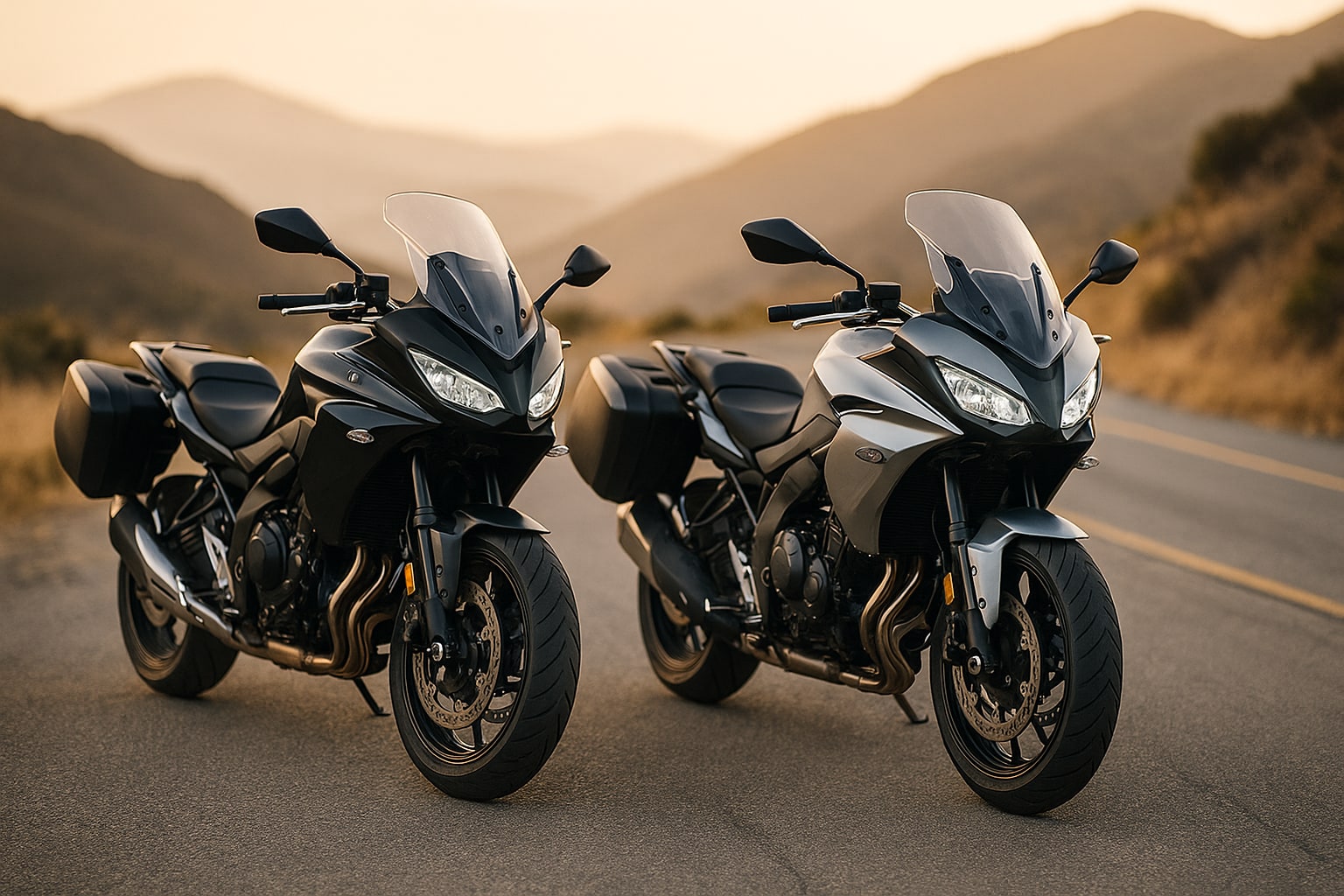
Two different ways of understanding middleweight sport-touring
If you’re looking for a bike that does it all — commuting during the week, a weekend getaway and a long summer trip — and you don’t want to spend 15,000 euros, sooner or later you’ll end up looking at these two. The Suzuki V-Strom 800 and the Yamaha Tracer 7 are, in 2026, two of the most sensible options in this segment in Spain. But they are very different motorcycles: one comes from the asphalt-trail world, the other from a sporty naked bike repurposed for touring. And that shows in every corner.
Suzuki V-Strom 800: features and approach
The V-Strom 800 (we’re talking about the road version, not the DE off-road one) uses the 776 cc parallel twin with a 270° crankshaft that Suzuki introduced a couple of years ago. It produces 83 hp (61 kW) at 8,500 rpm and 78 Nm at 6,800 rpm, figures that are enough to carry two up with luggage without struggling.
Wet weight is 230 kg, and that’s its main drawback: it is not a light bike. Seat height is 825 mm and the tank holds 20 litres, allowing over 400 km between refuels with a real-world consumption of around 4.7–5.0 l/100 km in mixed use (Suzuki homologates 4.4 l/100 km WLTP).
Category A licence, though there is a A2-approved version (35 kW) for those who haven’t yet reached two years of licence holding.
Yamaha Tracer 7: what it offers and who it’s aimed at
The Tracer 7 uses the 689 cc CP2, the same 270° crankshaft parallel twin found in the MT-07, XSR700 and Ténéré. It delivers 73.4 hp (54 kW) at 8,750 rpm and 68 Nm at 6,500 rpm. Less power than the Suzuki on paper, but also considerably less bike to move: 196 kg wet.
Those 34 kg of difference change everything. Seat height 835 mm, a 17-litre tank and real-world consumption of roughly 4.3–4.6 l/100 km (Yamaha declares 4.3 WLTP). Practical range: about 370 km before the reserve light comes on.
Category A licence, with a factory-homologated A2 version electronically restricted.
Ergonomics, handling and suspension
Here the two take opposite paths. The V-Strom puts you in an upright position, with a wide handlebar and trail-style layout: comfortable from the first kilometre, good visibility of traffic and decent wind protection thanks to the manually adjustable windscreen. On the motorway at 130 km/h is where it shines most. In fast corners the weight shows, and the standard mixed-compound tyres (Dunlop D614) don’t help if you push hard.
The Tracer 7 is more of a rider’s bike. A slightly forward posture, narrower handlebar and a chassis that appreciates being asked for more. It comes with Michelin Road 5 or similar depending on the batch. The windscreen protects less than the Suzuki, and that’s a weak point: on long rides in the rain you’ll notice the air on your helmet more.
The suspension is conventional on both and adjustable only for preload and rear rebound (no semi-active units at this price). The Yamaha has a slightly firmer setup; the Suzuki is more touring-oriented.
Equipment and electronics: what each one includes
Suzuki V-Strom 800:
- ABS as standard (not cornering-aware, no IMU)
- 3-level traction control + off
- 3 riding modes (A, B, C)
- Bidirectional quickshifter as standard
- 5″ colour TFT
- No app connectivity, no integrated navigation
- Cruise control as standard
- USB socket
Yamaha Tracer 7:
- ABS as standard (not cornering-aware)
- 2-level traction control + off
- 2 riding modes
- Quickshifter optional (accessory pack)
- 5″ TFT with Y-Connect connectivity
- No cruise control, not even as an option
- No IMU
Here the Suzuki clearly wins: cruise control and quickshifter as standard at this price are a strong argument for anyone planning to cover serious mileage. The Yamaha falls short on electronics, and that matters in 2026.
Price in Spain, warranty and direct rivals
List prices checked in August 2026:
| Data | Suzuki V-Strom 800 | Yamaha Tracer 7 |
|---|---|---|
| RRP | 10,795 € | 9,699 € |
| Displacement | 776 cc | 689 cc |
| Power | 83 hp / 61 kW | 73.4 hp / 54 kW |
| Torque | 78 Nm @ 6,800 rpm | 68 Nm @ 6,500 rpm |
| Wet weight | 230 kg | 196 kg |
| Tank | 20 l | 17 l |
| Seat height | 825 mm | 835 mm |
| Real consumption | ~4.8 l/100 km | ~4.5 l/100 km |
| Warranty | 3 years | 2 years (extendable) |
| A2 homologated | Yes | Yes |
The 3-year warranty on the Suzuki is a real extra compared with Yamaha’s 2 years. Both brands offer financing through their dealer networks, but it’s worth comparing with your dealership because promotions change quarterly.
Direct rivals to keep on your radar: Honda NT1100 (bigger and more expensive, with DCT option), Kawasaki Versys 650 (older but very reliable) and Triumph Tiger Sport 660 (three cylinders, a different feel). If you’re more drawn to the naked-tourer style, also check out our review of the Honda NT1100 DCT as a clutchless sport-tourer to see what’s in the range above.
Verdict: who each one suits
Buy the Suzuki V-Strom 800 if you’re going to travel for real: two up, luggage, motorway and long stages. Cruise control and quickshifter as standard, the 20-litre tank and the upright position are hard arguments to beat at 10,795 €. Its clear weak point: it weighs 230 kg and that shows when manoeuvring at standstill and in fast corners.
Buy the Yamaha Tracer 7 if you do more short rides than long trips, value lightness and want a fun bike that also works for everyday use. It’s 1,100 € cheaper, more agile and has a CP2 engine that gets you going. Weak point: limited electronics (no cruise, quickshifter at extra cost) and lower wind protection.
If you’re unsure and your use is 70% city and secondary roads, go Tracer. If it’s 70% touring and motorway, go V-Strom. It’s that simple.
Technical and price data taken from the official websites of Suzuki Spain and Yamaha Motor Spain, August 2026. Real-world consumption figures estimated from user reviews and industry tests.