Marc Márquez analyzes the Aragón circuit
The Repsol rider goes through the Motorland Aragón track corner by corner, where this weekend the next round of the 2011 World Championship is held
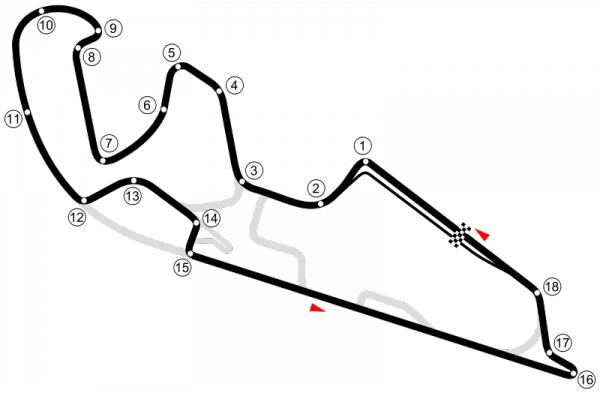
The Motorland Aragón circuit, located in Alcañiz, will host this weekend’s MotoGP World Championship round, and Repsol team rider Marc Márquez arrives having cut into Stefan Bradl’s lead in his personal battle for the Moto2 World Championship title.
This is the third home race for Marc, and the rookie of the year will surely be aiming to take his third consecutive win in such a fiercely contested category.
With 10 left-hand corners and 7 right-hand corners, and a length of 5,078m, the Aragón circuit is one of the longest on the championship calendar. It features a combination of fast and slow corners (some of them blind) and the famous “corkscrew”, excellent for overtaking.
Márquez has analyzed the circuit for us corner by corner:
- Turn 1: This is a 90º angle, where it is important to brake hard and set up a good exit, because two right-hand corners follow almost back to back, where you can gain a good deal of time.
- Turn 2: You need to take a good line to exit quickly, with enough speed to tackle the climb. It is also very important to find the right line so you can set up turn 3 properly.
- Turn 3: This is the most important of the two linked corners, because it is uphill and fairly fast, and this is where you can really gain or lose a lot of time, especially on new tyres.
- Turn 4: Here comes a difficult braking zone, because you start braking with the bike leaned over to reach the hard braking for turn 5. Braking while leaned over always costs more and carries the added danger of losing grip at the front wheel.
- Turns 5 and 6: Turn 5 is quite slow and you have to get on the gas well through to turn 6, which is taken practically flat out.
- Turn 7: You also brake with the bike leaned over here, as in turn 5, but this one is a right-hander. It is even a little slower.
- Turns 8 and 9: After a short straight comes the Motorland “corkscrew”. It is a fairly hard braking zone, downhill. You need to sacrifice well in this corner to change direction cleanly and get it right, because turn 9 is still downhill and you have to exit quickly onto the next straight.
- Turns 10 and 11: You shift up through the gears and take a long, fast sweeping bend. It is quite a difficult corner, because there is no visibility on the exit and it is a point where you can gain or lose a lot of time, especially if you are on new or worn tyres. It is important to exit quickly to gain some km/h on the straight that follows.
- Turn 12: This is one of the hardest braking zones on the circuit, a clear overtaking point, especially in the last laps. It is a 90º angle, where you need to carry good corner speed to set up the next one properly.
- Turn 13: This is a fast corner, taken without accelerating flat out, but with the throttle open.
- Turns 14 and 15: Another hard braking zone, since next comes the slowest chicane on the circuit, and it is difficult because it is downhill, which makes it harder to stop the bike. You need to set up the second corner well, because after it comes the longest straight on the circuit, and the km/h you gain on exit are very important.
- Turns 16 and 17: When you take it well and find the right line through the circuit, this is one of the most enjoyable corners on the track. These are two corners, but you take them as if they were one, fast and uphill, where you turn in, open up a little and close again while thinking about the exit. You have to get through the corner quickly, because the main straight comes next.
Source | Repsol

1 comment · Comment
1 comment