Ducati 1199 Panigale and its engineering
Through the images of the 1199 Panigale's designs, we are going to try to uncover some of its secrets.
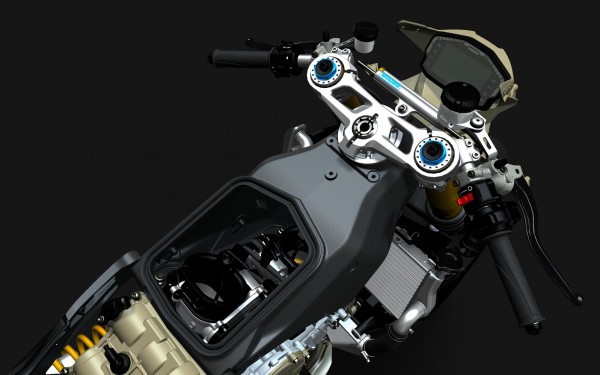
Just a few minutes ago, on the website of our colleagues at Asphalt & Rubber, whom we admire greatly, we discovered some photos of the CADs of the 1199 Panigale. These images bring us a little closer to this motorcycle, where we can discover a little better the secrets hidden beneath its beautiful bodywork.
We’ll begin by explaining what a CAD is for those who don’t know, although I’m sure many of you do know, I’m certain. CAD stands for English initials meaning “computer-aided design”, or in other words, computer-assisted design.
Today there are many programs of this type, Catia, Inventor, SketchUp (new software from Google), AutoCAD, and many more. For example, Inventor is quite famous in our country in the world of industrial engineering, while Catia is common in the aeronautical world, and AutoCAD in architecture, but more than anything it is a matter of habit, since practically all these types of programs serve almost the same purpose. I won’t deny that some are more complete than others. Regarding the latter, I’ll just point out a curiosity I have: is there anything Google can’t do?.
Now that we know a bit more about software and CAD, let’s delve a little into the analysis of the photos they have published.
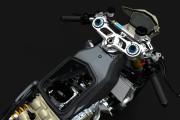
In the cover photo we can see the front part of the chassis, if it can be called that, since some refer to this motorcycle as “frameless” or monocoque. In this front structure is where the steering is attached, and it functions as an airbox, all in one piece. In this photo we’re discussing, we can clearly distinguish how the two intake trumpets are located inside the airbox (for those without a trained eye, they are the two black elliptical pieces).
The airbox is today a very important element, especially in high-performance motorcycles, as we saw a couple of days ago in the article From MotoGP to CRT, the engines, where with this element the standard Kawasaki went from 200 to 209 hp. To give a quick definition, which we will expand on in a future special article, an airbox is a box that increases the air pressure just before it enters the engine.

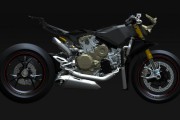
In this second photo we can see how the radiator is divided into two parts, upper and lower, the upper one for the cylinder located behind the airbox and almost under the seat, and the lower one for the second cylinder. It surely wasn’t made as a single piece because of the now-famous rotation given to the engine.
Now, if we focus on the rear shock absorber, we see two details: first, that it is anchored to the engine, and second, the “bellcrank” system (if it can be called that), which makes it work more progressively. We also suspect that part of the damping will be converted into rotation of the shock absorber.

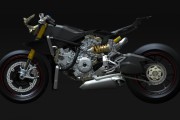
Moving to the side view, we already admire how the engine has been used as an important part of the chassis. To it are attached the swingarm and subframe at the rear, and the airbox with the steering head at the front.
Finally, we should mention the exhaust pipes, short and low beneath the whole system, surely to lower the center of gravity a little and centralize it in the engine. I’m sure they also have an aerodynamic purpose, since the new Moto3 bikes also route the exhaust through that area; we’ll have to investigate.

Photos | Asphalt & Rubber
3 comments · Comment
3 comments
Es una pasada, extraña, pero una pasada. Es cosa mía o es más pequeña en dimensiones que la 999 o la propia 1198?
Aunque parezca mentira la distancia entre ejes es 7 mm superior a la 1198, lo que pasa que viendola con el carenado da impresión de ser muy pequeña ya que todo sale de muy adelante.