BMW C600 Sport, the test!
The BMW C600 Sport maxi-scooter is comfortable, fast and agile, very good for all kinds of use.
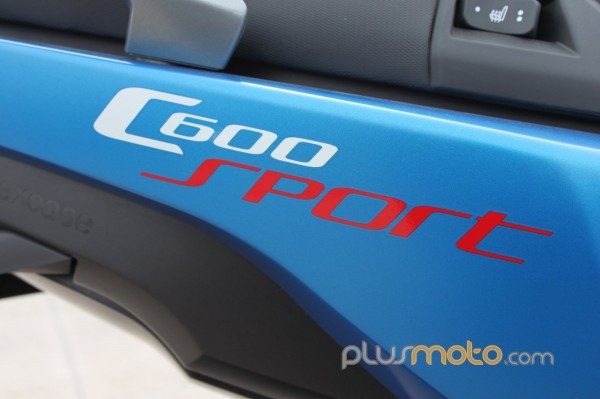
When we went to meet these two maxi-scooters (the BMW C600 Sport and the C650 GT), the first thing that caught our attention was why one is called a 600 and the other a 650? Well, it has nothing to do with the engine displacement: both have the same one, 647 cc, and the engines are identical in both versions. The solution comes from the company’s marketing, where “600” is strongly linked to the sporting world, and this is the character they want to give this version.
Next we analysed it from the outside. The fairings are of high quality, design and finish, creating a very attractive line, especially the sport version, which is what they wanted for the BMW. The front fender leaves the suspension bars exposed, creating a very eye-catching ensemble.

The front lighting has two headlights which, on this version, came with LED daytime running lights (optional), located on the sides of both. The indicators built into the fairing are part of the line; admittedly they are somewhat less striking than the GT’s, which sit on the mirrors. The rear lighting has two indicators on the number plate holder (LED is offered optionally) and a large brake light.
As for the seat, it looks quite large for two people. The passenger footrests fold away, unlike on the GT, and the two rear grab handles are well designed to offer passenger comfort while also contributing to the bike’s design. Now we look under the seat: there is room for one helmet and a bit more. One of the new tricks of the BMW is the FlexCase, a “glovebox” that opens when the bike is parked and lets you fit a second helmet. It’s undoubtedly a brilliant idea. It also has a warning on the dashboard that indicates when it is open, so you cannot start the bike with it open and you will be alerted if it opens unintentionally.

Once we’re on the bike, the analogue speedometer and the on-board computer screen are in the right position so you don’t have to take your eyes off the road. It gives you more information than necessary to keep everything under control. The controls allow a slightly more upright position than on the GT, though it never becomes uncomfortable. The handlebar buttons are easy to operate and have enough space so they don’t interfere with each other when pressed. The screen is adjustable manually to three positions; we recommend the second for today’s conditions (cloudy and windy). Finally, the mirrors, although they look somewhat small, are positioned at a distance that gives very good visibility.
Now it’s time: we start the bike and check the throttle feel. It’s easy to find a smooth take-off thanks to the play it allows at the start. We also check the brakes: the rear lets you do whatever you want at low speeds, and the combined braking stops the bike in an instant. We’ll see how it behaves at higher speed.
We leave the Jarama circuit and head for Plaza Castilla along the A-1 towards Madrid. Here we already begin to sense the virtues this scooter has on the motorway: very good acceleration, even approaching the limits set by the traffic regulations. It never falls behind, even when we have to make an “in extremis” overtake; the response is immediate and full of power. Likewise, the braking, though not yet very demanding, is sufficient to get back into line behind the other bikes.

Just before reaching Plaza Castilla we come to an intersection which, in my opinion, is one of the most complicated in Madrid. We have to change several lanes quickly amid heavy car traffic, but the raised riding position this bike gives us provides the visibility needed to keep the vehicles ahead under control and the ones behind in the mirrors. We make a little play with throttle and brake and get to where we need to go. Test passed!
Once in the city of Madrid, all that’s left is to turn around and take the A-1 again, this time heading towards Burgos, towards the mountains outside the capital. Now, with open road ahead, we start testing the heated systems for the grips and seat. They have three modes: automatic, which is configured according to several parameters such as speed, engine temperature and outside temperature; and 100% and 50%. I must say that on this version the automatic and 100% modes heat up too much, especially the seat. I should clarify that this is, at least to my taste, although the afternoon conditions were quite cold; perhaps in other areas and conditions it would be necessary. This, together with the fairing system, are really the only drawbacks I would point out. The screen vibrates a lot, and after seeing the GT’s electrical system you won’t want anything else. To operate the heating on the passenger seat, there is a separate control panel on its right-hand side.

On twisty roads it behaves like a true motorcycle, leaving the scooter character aside: it enters and exits corners with precision, and in the event of any problem the combined brake gets us out of trouble. This behaviour is partly due to the mixed chassis and the suspension set-up, which in this version has a slightly firmer configuration that makes it better suited to this kind of road. The ABS is not intrusive at all and only activates when it is really needed. More than one rider will have experienced it on the speed bump leaving Patones.
As for vibrations, nothing to add: the bike stays almost always in the same rev range, which transmits just the right amount of vibration to let you feel the bike.
In conclusion, a very good option to the T-Max world, and it’s clear that the company has put a great deal of effort into improving on the competition. The base price is 10,900 euros, and it will be on sale from 14 April.
Photos | BMW, Alejandro Batán (Plusmoto.com)


5 comments · Comment
5 comments