The GP Commission makes changes to the MotoGP rules
The Grand Prix Commission, made up of Carmelo Ezpeleta (Dorna, President), Ignacio Verneda (FIM Executive Director), Hervé Poncharal (IRTA) and Takanao Tsubouchi (MSMA), in the presence of Javier Alonso (Dorna) and Mike Trimby (IRTA, meeting secretary), has decided to make some changes to the regulations of the Motorcycle World Championship.
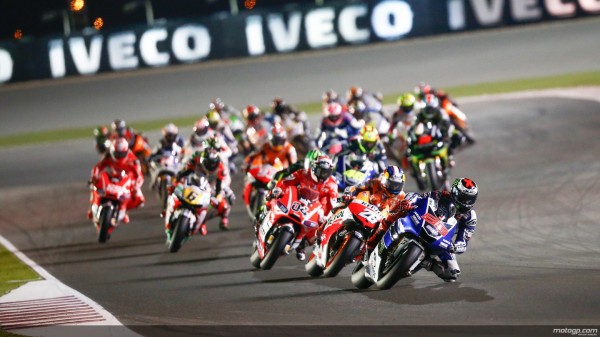
The Grand Prix Commission of the Motorcycle World Championship has made some updates to the regulations of the Motorcycle World Championship, so there is some news that should be kept in mind.
This Commission is made up of Messrs. Carmelo Ezpeleta (Dorna, President), Ignacio Verneda (FIM Executive Director), Hervé Poncharal (IRTA) and Takanao Tsubouchi (MSMA), in the presence of Javier Alonso (Dorna) and Mike Trimby (IRTA, meeting secretary), at a meeting held on 4 April 2013 in Losail.
Below you can see the changes and updates to the regulations:
Technical Regulations
- MotoGP Category
The new technical regulations effective from 2014, which were approved at the GPC meeting held in Valencia in November 2012 and already announced, have been confirmed in all their aspects following the successful conclusion of negotiations between Dorna and the manufacturers regarding the additional supply of motorcycles and/or engines for the MotoGP category from 2014.
For safety reasons, it was agreed that Race Direction could authorise a type of brake disc with a different specification for use at specific circuits. At present, the only circuit where discs of a type other than that set by the regulations may be used is Motegi.
- Moto3 Category
Changes to the regulations relating to the supply of engines in the Moto3 category have been approved. The aim is to reduce the engine programme costs for teams and to ensure that there is equal performance between engines supplied by the same manufacturer.
From 2014 engines will be supplied to the Championship Organiser by the manufacturers in three batches throughout the season. The engines will be sealed and randomly distributed by the Technical Director and will become the property of the teams, without any need to return them under any “service contract”. When an engine has completed its normal cycle of use, it will be replaced by another sealed engine, and the six engines are expected to be more than sufficient for the season. At the end of the season, the team will own six engines with a minimum accumulated mileage, which may be used for testing or sold. The price of the engine package covering the season has been set at €68,000.
The concession authorising the replacement of timing chains at regular intervals for engines Honda, which requires breaking the engine seals, will be extended until the end of 2014. From 2015, the maximum Moto3 engine speed will be 14,000 rpm reduced to 13,500 rpm, and chain replacement will no longer be permitted.
Sporting Regulations
For the 2014 season (from 11 November 2013):
The new restrictions will come into force for the MotoGP category, including the limitation on the number of tests that riders contracted by the manufacturers may carry out:
- One official three-day test at a European circuit between the last race of the year and 30 November.
- Three official three-day tests between 1 February and the first race of the season.
- A maximum of three one-day tests, each on the Monday following the races designated by Dorna/IRTA in Europe.
- Any activity authorised by Race Direction.
Tests are not permitted between 1 and 31 January, both dates inclusive.
Test riders, unlike the others, may continue development work at any time, at any circuit, respecting the “test tyre” allocation assigned to each team. This rule also applies to the riders of the CRT teams, who may test at a Grand Prix circuit, provided they have authorisation from Race Direction.
Test Regulations – Moto2 and Moto3 Categories
Several changes to the regulations governing tests in the Moto2 and Moto3 categories were approved.
- Tests are permitted at any circuit, with any rider, between the last GP of the year and 30 November.
- The three official pre-season tests will be held with the riders contracted for the season, at European circuits designated by Dorna/IRTA.
- Teams may also choose one GP circuit and one non-GP circuit to carry out tests from 1 February, with any rider, but never during the 14 days prior to a race at the circuit in question.
- Teams may also take part in tests organised on the Monday and/or Tuesday after European races, when no MotoGP category tests are held on those days.
- Any activity authorised by Race Direction.
Tests are not permitted between 1 and 31 January, both dates inclusive.
FIM Medical Code
Several amendments to the FIM Medical Code have been confirmed. These changes aim to better define the functions and responsibilities of the Chief Medical Officer, the Medical Director and the FIM Medical Representative (formerly the FIM Medical Observer). These changes also recognise the presence and role of the “FIM World Championship GP Medical Team”.
This team is a group of doctors experienced in managing serious trauma. Its role will be to provide immediate medical assistance trackside in the event of serious injury, before transport to the medical centre or hospital. The team will travel in rapid-response medical vehicles to work alongside the local medical staff.
Source | MotoGP Official website
1 comment · Comment
1 comment