Pre-race interview ahead of the 2011 Moto2 World Championship with Marc Márquez (II)

Don’t miss the second part of the interview with the 125cc World Champion, Marc Márquez, who in 2011 takes on a new challenge in the Moto2 class, becoming one of the favorites from the very start thanks to his rapid adaptation and the pace he set during testing.
The Catalan has had a very positive pre-season; now the question is whether he can withstand the pressure and pace of the other riders, who have much more experience.
Below you can watch the second part of the interview with Márquez:
Do you remember 7 November 2010?
Valencia, right? Honestly, it already feels quite far away.
The whole winter has gone by and I haven’t stopped doing things, appearing in the media, and it all went by fairly quickly and a bit tiringly. It was a very short winter that is practically over now, and I’m only thinking about Moto2 now.
After all of that, doing the World Championship and travelling to a different country every two weeks almost seems relaxed by comparison.
Yes, because travelling to races is different from travelling to train. Taking a plane somewhere to receive an award or do an interview, and then coming back, becomes a bit more of a burden.
What I enjoy is riding motorcycles, and what I want is to be on track, so travelling to races is done with a very different attitude.
You adapted very quickly to the new class. What has been the key to that adaptation?
I’m sure the training I’ve received from Emilio [Alzamora] over all these years has helped me a great deal. When I started working with him at 12 years old, from the very beginning we worked a lot not only on the line around the circuit, but also, when we stopped in the pits, he would tell me how I had to explain my feelings on the bike and what I had to focus on when riding on track.
You see that it’s important to notice the differences at certain moments of the corner: when entering under braking, when you release the brake, in slow corners, fast corners, when you open the throttle, and so on. In the afternoons we would look at the telemetry and, although I was very young, he explained many things to me, compared it with what professional riders were doing, and all of that experience has served me very well.
Last year in Moto2 we saw very fast riders who came both from MotoGP and from the 125cc class. What style do you think adapts best to going fast in Moto2?
The style required is that of a four-stroke bike, taking into account engine braking, weight, and so on.
You have to understand the bike and work out what you need to improve in order to go fast. After all, it’s a motorcycle, and any rider can end up going fast, whether from 125cc, 250cc or MotoGP.
Achieving a difference that lets you run with the front runners and score podiums is where the difficulty lies. For that, I think a rider coming from MotoGP will find it easier, because they have already ridden heavier, faster bikes with four-stroke engines and a lot of electronics. When you come from 125cc you have to learn many more things, but it depends a lot on each rider.
What is needed to be at the front with so many riders on track?
You have to work hard to achieve a good pace and to understand the team well.
Since the engines we use are identical for everyone and there are few differences in the chassis, you have to work closely with your technical team, which has to be good, so that you can then make the difference on track yourself.
For that, will work in qualifying be even more fundamental, to secure a front-row place on such a crowded grid?
Yes, Saturday will play an important role, in trying to get as far forward on the grid as possible, which will also be three riders deep. Even so, we still have to keep working hard on race pace, because in Moto2 is where the real difference is made.
This year the tyre supplier is bringing new compounds. Do you think they will play a more important role?
Certainly, because it’s the part of the bike that is in contact with the asphalt, and however well the bike is set up, if the tyre isn’t right, the bike won’t go well.
In any case, for the races we only have two compounds, one harder and one softer, and there won’t be much difference. Either way, it’s welcome that Dunlop is working on new things, because it helps the competition and gives more safety on track.
With a bike so different from the 125cc, what aspects change the most in the set-up? What do you focus on most in training?
The set-up work isn’t very different from last year, because the things that change the most, such as the engine and engine braking, are aspects that are touched very little.
What you work on during training is adjusting the chassis setup, the suspension, and choosing the best tyre, and that’s the same as on a 125cc.
With a single engine, the difference, besides the rider and their work with the team, is set by the chassis. What are the strengths of yours?
I wouldn’t be able to tell you, because I haven’t tried any other chassis, I haven’t ridden four-stroke bikes, and I’m still getting to know mine.
Who do you think will be the strongest rivals in the class?
Those who have been seen this pre-season or were seen last season, like Simón, Iannone, Bradl, Takahashi, Redding, Corsi… They are riders who already have experience.
How do you feel about them placing you among the favorites? Do you think you can be up there?
I don’t know. If they consider me a favorite, that means I’m working well and on the right track, although this year isn’t our war either. If we can be up there, great. If not, nothing happens.
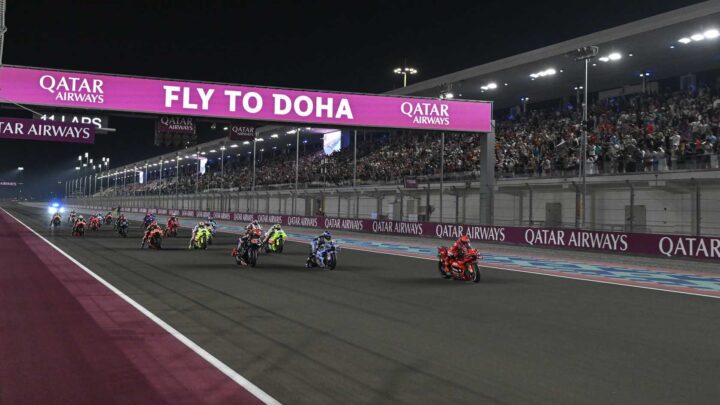
The first race is in Qatar, a circuit where last year you had quite a few set-up problems in training. What did you learn from that race?
I learned that you can’t win every race to win a Championship. When you have problems, you have to know how to finish third or fourth and pick up points.
A year ago we didn’t find a good set-up and I couldn’t go any faster, I didn’t ride comfortably, and it was one of the few races where we had suspension problems. It’s also true that the team was still very new, we didn’t know each other well enough and hadn’t worked together much.
Even so, we got a third place, which in the end helped us win a championship.
We’ll keep an eye on Marc Márquez.
Source | Repsol Media Service
1 comment · Comment
1 comment